Diplomatic Goals: Fostering Soft Diplomacy Through Sport and International Education
In an increasingly interconnected yet geopolitically complex world, traditional state-level diplomacy often feels distant from the lives of ordinary people. True bridges between cultures are rarely built in summit rooms alone. More often, they take shape on university campuses, inside study abroad cohorts, and across the chalked lines of a football pitch.
As the world turns its attention to the historic FIFA World Cup 2026 across North America, a powerful parallel emerges between two seemingly different sectors: international education and global sport. Both rank among the world’s most effective engines of soft diplomacy, capable of breaking down cultural stereotypes, fostering genuine empathy, and turning students and athletes into global citizens in ways that no policy document can replicate.
“Whether through an academic seminar or a 90-minute match, the ultimate goal is the same: connection.”
The Architecture of Soft Diplomacy
Soft diplomacy operates on the currency of shared values, culture, and mutual understanding rather than coercion or leverage. It works precisely because it does not announce itself.
When a student packs a suitcase to study abroad, they are not simply registering for foreign university credits. They are entering a months-long immersive diplomatic mission. They navigate new linguistic nuances, dismantle preconceived cultural biases, and build lifelong international networks that no classroom lecture could have produced on its own.
The World Cup functions as a hyper-concentrated version of that same phenomenon. It is a rare cultural arena where nations meet not to clash over borders or trade, but to speak a universal language: the language of football. The shared joy of a well-struck goal or the mutual respect earned through a hard-fought match does more to humanize the other side than decades of policy whitepapers ever could.
Study Abroad as Diplomacy
Students living and learning abroad spend months navigating cultural nuance, building the kind of deep empathy and cross-cultural competency that shapes how they engage with the world for the rest of their lives.
Sport as Common Ground
Football creates a shared emotional language that transcends politics, language, and geography. The 2026 World Cup will bring that language to over five billion people watching across the globe.
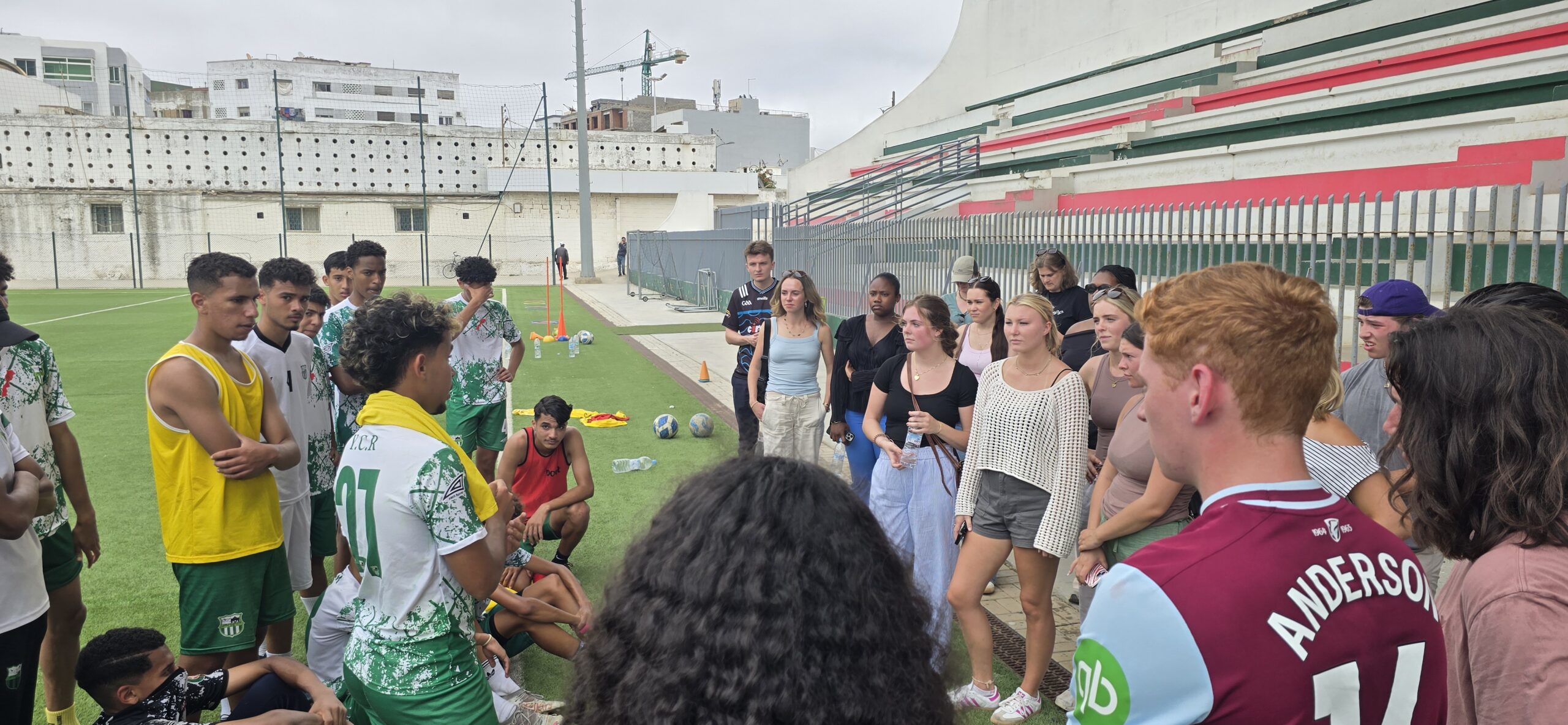
University of South Carolina students visiting the Mohammed VI Football Academy in Rabat, Morocco.
The MOBT Global Soccer Academy
Recognizing the profound intersection between global education, athletic passion, and intercultural literacy, MOBT Global has built something designed to meet this moment: the Soccer Academy.
Free and open to students, faculty, and study abroad professionals alike, the Soccer Academy takes learners through five focused lessons covering the rules of the game, the history of the World Cup, and the stories of the legends who shaped it into the global phenomenon it is today. A 25-question assessment at the end of the course gives participants the chance to earn an official certificate of achievement issued by MOBT Global.
Why This Matters in the Era of Multi-Nation Hosting
The 2026 World Cup is rewriting the playbook. By spreading 104 matches across 16 stadiums in Canada, Mexico, and the United States, it mirrors a broader shift already well underway in international education: moving away from isolated, single-city experiences and toward dynamic, comparative, multi-country learning.
For students and professionals engaged in this space, the World Cup is not just a sporting event to follow. It is a live case study in intercultural coordination, cross-border logistics, and the kind of large-scale international collaboration that defines the field they are preparing to enter. The competencies being tested right now on the pitches of North America are the same ones that make a study abroad professional effective on the ground.
01
Intercultural Communication
Understanding how to engage meaningfully across cultural boundaries, whether in a stadium, a seminar room, or a partner meeting in a foreign country.
02
Operations Across Borders
Executing complex programming across multiple countries demands the same planning, flexibility, and coordination that powers great international education programs.
03
Sport for Social Development
Football has long been used as infrastructure for building community and driving measurable social integration in host cities around the world.
Scoring Goals Off the Pitch
When study abroad professionals and international sports educators align, the results tend to be greater than the sum of their parts. We are not simply training future sports executives or international consultants. We are shaping the empathetic, culturally competent leaders that a complicated world genuinely needs right now.
As fans fill the stadiums this summer and students learn in foreign classrooms, the same core truth holds across both settings. The most effective diplomacy is not announced in press releases. It happens in the moments of connection that follow, when strangers from different countries find they share something real.
MOBT Global is proud to contribute to that mission through the Soccer Academy and the FIFA World Cup 2026 Match Schedule, two free resources built for anyone who wants to engage with this moment more deeply. Sometimes, the most effective diplomacy happens with a notebook in hand and a ball at your feet.
About the Author